
Payroll Administration
Monthly salary calculation, income tax withholding, social contributions, and disbursement, delivered with audit-ready documentation.

HR Administration for Your Belarusian Entity
International companies that run a Belarusian subsidiary, branch, or HTP-resident entity face the same recurring problem. The local operation needs a full HR and payroll function. However, building one in-house is slow and expensive.
A Professional Employer Organisation (PEO) solves it. Under a PEO arrangement, the client keeps its Belarusian legal entity and remains the employer of its staff. SPEX takes over the administrative side — payroll, personnel records, statutory reporting, and labour law compliance.
The distinction matters. PEO services in Belarus suit companies that already have, or are setting up, a local entity and want to outsource the back office rather than maintain it internally. Companies hiring in Belarus without any local entity need a different model — see our EOR services.
Under a PEO engagement, the client directs the workforce and signs the employment contracts. Meanwhile, SPEX administers everything that surrounds those contracts.
In practice, our PEO service covers payroll calculation and disbursement, personnel records and the kadrovy uchyot (HR file-keeping required by Belarusian law), statutory reporting to FSZN, Belgosstrakh, and the tax authority, leave and sick leave administration, and ongoing labour law compliance. As a result, the client’s managers focus on the team and the business. The administrative and regulatory load sits with us.
This model works particularly well for international companies whose Belarusian entity is small or mid-sized. Below a certain headcount, a dedicated in-house accountant and HR manager cost more than they return. A PEO converts that fixed overhead into a predictable service fee.
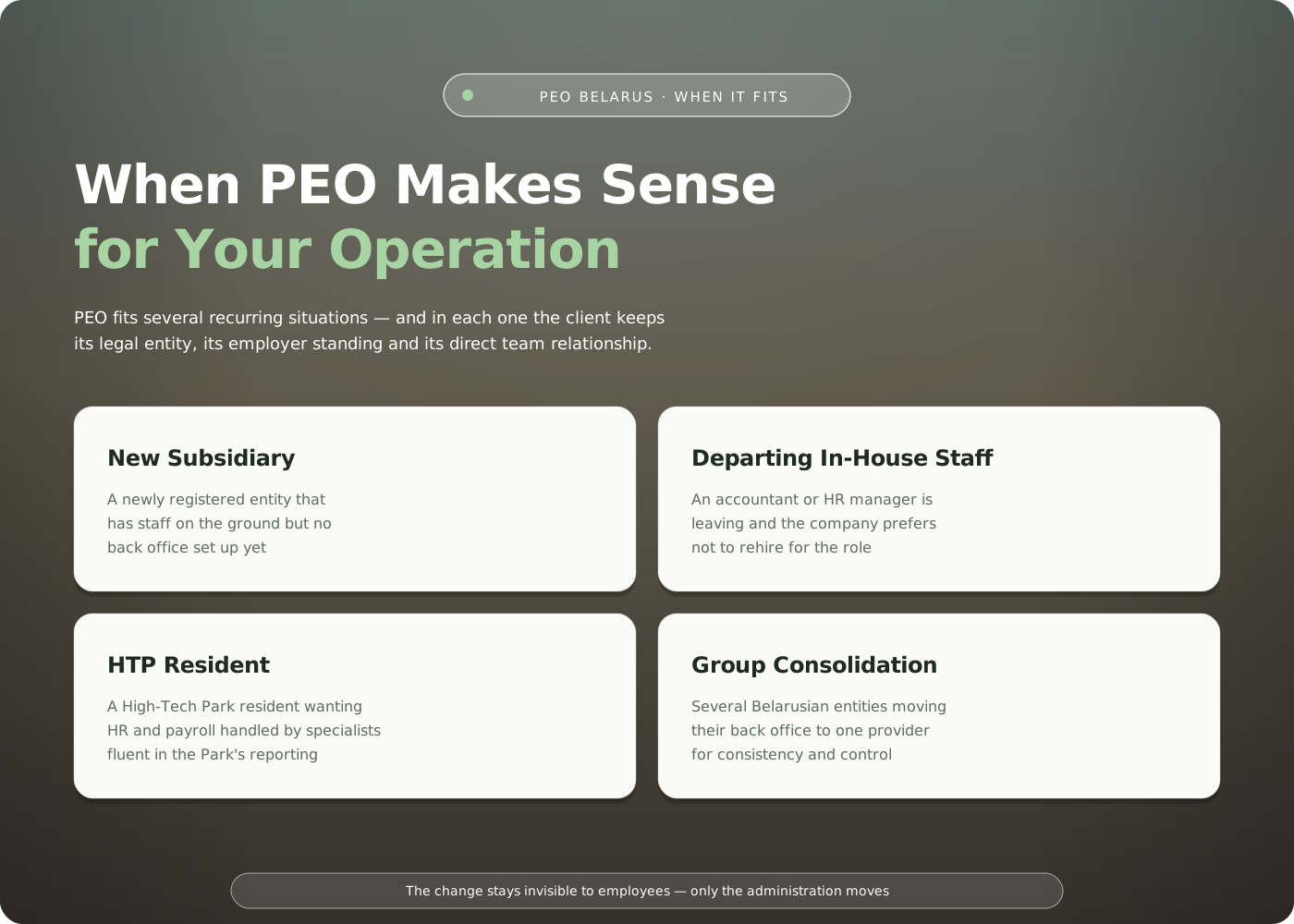
PEO fits several recurring situations.
First, a newly registered subsidiary that has staff but no back office yet. Next, an established entity whose in-house accountant or HR manager is leaving, where the company prefers not to rehire. Then, an HTP resident that wants its HR and payroll handled by specialists familiar with the Park’s reporting regime. Finally, a group consolidating administration — several Belarusian entities moving their back office to one provider for consistency and control.
In each case, the client keeps its legal entity, its standing as employer, and its direct relationship with the team. As a result, the change stays invisible to employees. Only the administration moves.
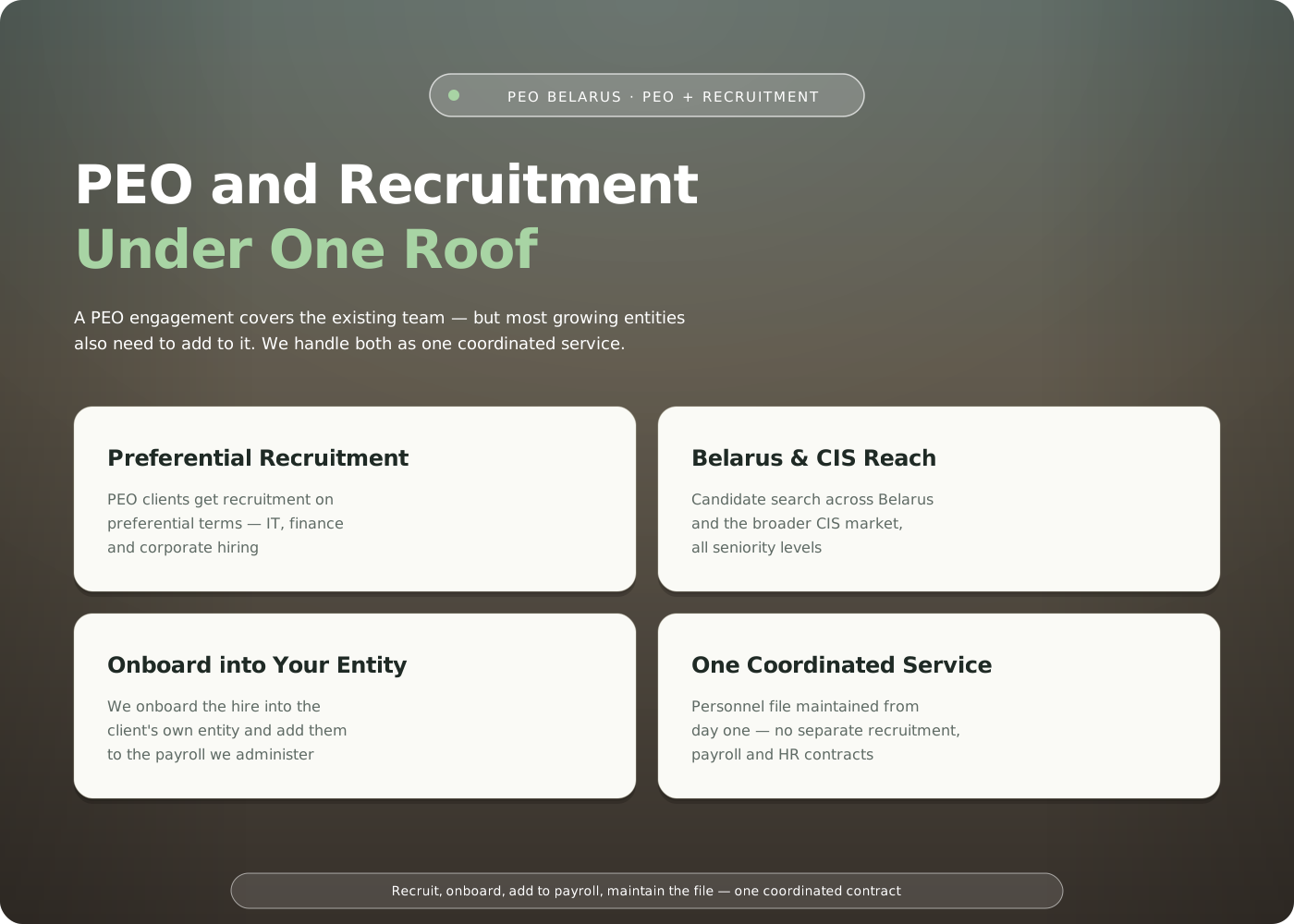
A PEO engagement covers the existing team. However, most growing entities also need to add to it. Our recruitment practice supports PEO clients on preferential terms — IT, finance, and corporate hiring across Belarus and the broader CIS market.
The combination is practical. We recruit the candidate, onboard them into the client’s entity, add them to the payroll we already administer, and maintain their personnel file from day one. As a result, the client receives one coordinated service instead of separate recruitment, payroll, and HR contracts.
PEO and EOR both outsource the employment back office, but they differ on who is the legal employer. Under PEO, the client keeps its Belarusian entity and remains the employer; SPEX administers payroll, HR records, and compliance. Under EOR, SPEX is the legal employer, and the client needs no local entity at all. As a result, PEO fits companies that already operate in Belarus, while EOR fits companies entering the market without incorporating.
Yes. PEO is an administration model for companies that already have, or are registering, a Belarusian entity. If you want to hire in Belarus without a local entity, the EOR model applies instead. We help clients choose the right structure at the first consultation.
Article 26 of the Labour Code sets the list. It includes a passport or residence permit, military registration documents where applicable, a labour book (except for first-time employees and part-time workers), a document confirming education where the role requires qualification, and a state social insurance certificate. The contract is concluded in writing in two copies and specifies the start date.
Full working time cannot exceed 40 hours per week, for both five-day and six-day weeks. Reduced hours apply to certain categories — for example, 35 hours per week for Group I and II disabled employees. The Ministry of Labour and Social Protection sets the calculated annual working time norm each year.
Employers make mandatory contributions on top of gross salary. Social insurance contributions to the FSZN total 34% of payroll (28% pension, 6% social), plus an industrial accident insurance premium to Belgosstrakh at a rate set by risk class. Personal income tax of 13% is withheld from the employee’s salary, not added on top.
The standard rate of personal income tax on salaries and civil-law contract payments is 13%. Standard, social, property, and professional deductions reduce the taxable base where they apply. The employer withholds and remits the tax monthly.
Employees on an employment contract are entitled to annual leave of at least 24 calendar days. Additional leave applies for irregular hours, long service, or hazardous conditions. The employer must set the leave schedule for the year by 5 January. State holidays falling within the leave period are not counted and not paid.
Temporary incapacity is confirmed by a medical certificate. Sickness benefits are paid from the Social Protection Fund — 80% of average daily wage for the first 12 calendar days, 100% thereafter. Employers may grant up to three days of sick leave without a certificate where local regulations allow.
Yes. Most PEO engagements start with an existing team. We review the current payroll and personnel records, correct any gaps, and take over administration without interrupting salary payments or changing anything for the employees.

The HTP Startup Center is one of the key support instruments for early-stage technology projects within the High-Tech Park (HTP). It is designed to help teams move from an idea to a sustainable business model, minimizing legal, organizational, and financial barriers at the outset. For entrepreneurs and IT teams, the Startup Center serves as a […]

Angel investments are a key financing mechanism for early-stage startups and innovative projects. They provide not only capital but also experience, contacts, and strategic guidance. Unlike venture capital funds, angel investors usually act individually, risking their own money for promising ideas and teams that can impact the market. In Belarusian and international startup ecosystems, angel […]

Registration as a resident of the High-Tech Park (HTP) is traditionally perceived as a tool for tax optimization and access to a special legal regime for IT businesses. In practice, however, the HTP’s approach to reviewing applications is not universal. Depending on the declared type of activity, different requirements apply to applicants, and for certain […]